
 by
by The U.S. Department of Justice finalized new rules in April 2024 requiring state and local governments, including public colleges like Herkimer County Community College, to make their websites, mobile applications, and digital content accessible to individuals with disabilities.
Compliance deadlines were originally set with requirements beginning in April 2026.
At HCCC, efforts to meet those expectations are already underway, though administrators say the scope of the work has already presented significant challenges.
To handle these challenges, the college formed an accessibility-focused group, known as the Electronic Information Technology Accessibility (EITA) committee, to address compliance with the federal standards and coordinate changes across departments.
According to Josh Parkinson, Director of Instructional Design and co-chair of the EITA, institutions are required to ensure that all digital content meets accessibility guidelines or risk significant penalties.
“The Department of Justice will come to us and say ‘everything has to be up to those standards’’’ he said. “If they’re not, schools can suffer an extraordinary amount of financial burden.” In practice, financial penalties of this scale can place pressure on institutional budgets, potentially affecting hiring decisions, resource allocation, and in some cases, requiring departments to absorb compliance costs internally.
Even as the rules establish a national standard, institutions are now facing pressure to update large volumes of existing digital content that were never originally designed with accessibility requirements in mind.
“We had 90 days to make an entire campus accessible,” Parkinson said. “Thousands of images… every single one had to be fixed.”
For students, this can show up in practical ways, such as course PDFs that cannot be read by screen readers, images without descriptions, or online assignments that are not navigable without a mouse. It can also include materials that rely heavily on color alone to convey information, which can create barriers for students with color blindness when distinctions between charts, graphs, or highlighted text are not supported by additional labels or formatting cues.
The timeline before the extension made full compliance difficult to achieve immediately.
“We knew we probably weren’t going to be 100% complete,” he said. “We were going to have a plan.”
Parkinson described his role as helping faculty design online courses that are accessible to all students. “My role is to teach teachers how to teach online,” Parkinson said. “Making sure the aesthetics, the appearance—all things online—flow for all kinds of students.”
That includes students who may not always communicate when they are struggling to access course materials.
Faculty training also presented challenges, particularly during the busiest part of the academic calendar, where teachers are rushing to put in grades and get their students ready for final exams.
“I’m trying to push up a hill,” Parkinson said. “I’ve got a few people helping me but everybody else is just looking at me like that’s too big for me right now.”
“These kinds of things don’t really get talked about because of the stigma,” he said. “People don’t like to say they have a learning disability… so they just don’t talk about it, and then their grades fall.”
Bringing a college’s digital systems into compliance involves more than updating a single website. It includes reviewing thousands of documents, images, and course materials used across departments.
A recent extension to the compliance timeline shifting the deadline to April of 2027, has allowed the college to shift its approach, focusing more on long-term implementation rather than rapid completion.
“It’s not going to be ‘just do it and get it done,’” he said. “It’s going to be more like, ‘here are milestones, let’s talk about it, let’s implement it.’”
The updated approach allows expanding training for faculty and prioritizing the most critical accessibility issues first, while continuing to work toward full compliance.
Parkinson said understanding the purpose behind the changes is key to getting faculty to engage with the process.
“If we can’t tell them the why, they can’t make a connection,” he said. “But if I can say we’re doing this to make content better for all people, then it makes sense.”
As digital platforms continue to play a central role in education, institutions across the country are expected to continue adjusting their digital presence as compliance deadlines approach. For HCCC, officials say the focus now is on maintaining steady progress while building long-term systems that prevent future accessibility gaps.
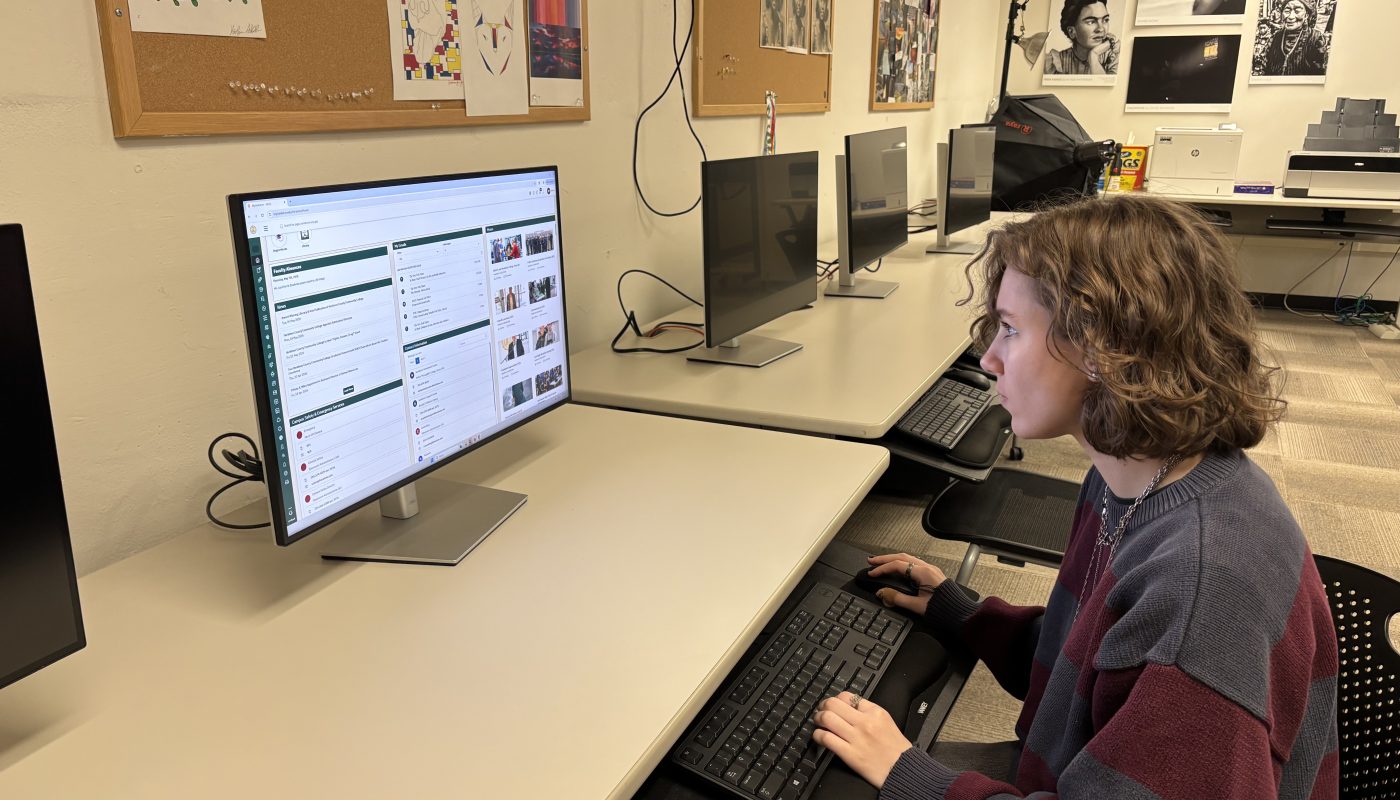
Photo by Rachael Defraine
